A century ago, the region that is now known as Palestine was a part of the Ottoman Empire. The Ottoman empire was overthrown in the first major genocide in human history, and the British Imperial Empire acquired the territories when the Turkish Republic was founded.
In a letter to Lionel Walter Rothschild in 1917, the then-British Foreign Minister Arthur James Balfour stated that the British Church had supported Jews’ efforts to establish Palestine as their homeland. The city eventually became the one that sparked the establishment of the Zionist state of Israel.
The document, also known as the Belfour Declaration, briefly addresses the civil and religious rights of Arabs but leaves out their national political rights while they were still residing on these areas.
Jews accounted up 9% of the population of these territories at the start of British rule. British Jews immigrated to Palestine with the assistance of the British, and between 1922 and 1935, the percentage reached 27%.
The establishment of Israel
Jews began to move in considerable numbers to Palestine after the Nazis’ horrific ethnic cleansing of European Jews during the Second World War. The British government established a law in 1939 to limit the number of Jews migrating to Palestine to 10,000 per year, but as a result of Nazi brutality, the number of Jews migrating began sharply rising.
On November 29, 1947, the UN General Assembly passed a resolution dividing Palestine between Arabs and Jews in the wake of World War II. Israel became an exclusive nation for Jews as a result of this resolution.
When the Arab delegates departed the meeting, it was evident that the Arabs of Palestine did not accept the UN General Assembly’s decision in any way, according to a New York Times report from the time.
The Jewish National Council met at the Museum of Tal Aviv on May 14, 1948, to declare the state of Israel as the British occupation of Palestine came to an end. The state was recognized by the United States the same evening, and the Soviet Union, the world’s second-largest power at the time, recognized it three days later.
The 1948 of war
The proclamation of Israel’s foundation resulted in a protracted war between Israel and its surrounding Arab governments. Israel’s victory in the attack resulted in higher territorial holdings than those previously determined by the UN.
With Israel’s victory, more than 700,000 Palestinians were forced to leave their homes. The Palestinians refer to their exile as the “Nakba,” or catastrophe.
Millions of Jews immigrated to Israel between 1949 and 1960. Jews who survived the Holocaust under Nazi rule immigrated to Israel in excess of 250,000.
Formation of PLO
The Fatah organization, which has its headquarters in Kuwait, a small Gulf nation, was founded by Yasser Arafat and a number of his associates in 1959.
After conversations with Yasser Arafat and other Palestinian independence fighters, the Palestine Liberation Organization (PLO) was established with the support of all the leaders. The formation of a coalition to advance Palestinian independence was seen as having taken place.
Arab-Israeli War
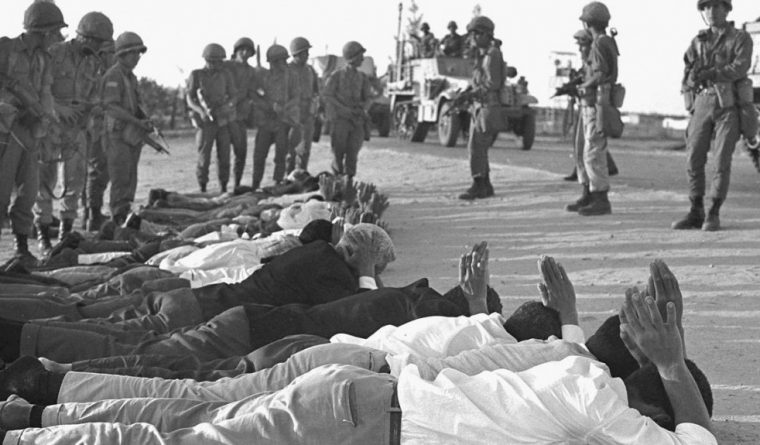
A six-day conflict between Israel, Syria, Egypt, and Jordan erupted in 1967. Israel managed to prevail even in that battle, and the highlands of East Quds, the West Bank, Gaza, the Golan, and the Sinai were all annexed by Israel.
Even though Israel controls a sizable portion of the Golan and the West Bank, Sinai was given back to Egypt in 1978 as part of a Camp David agreement with Egypt. Israeli settlements in Gaza were all abandoned in 2005.
The 1973 of war
The 1973 conflict, also known as the Battle of October, involved Israel’s allies Egypt and Syria. By the end of October of that year, the conflict was ended through the United States after both sides reached a peaceful settlement.
Yasser Arafat’s peace speech
Yasser Arafat, the Palestinian leader, denounced the labeling of Palestinian combatants as terrorists in an address to the UN General Assembly on November 13, 1974.
“If the Palestinian Mujahideen (fighters) are terrorists, then the American people’s struggle to liberate themselves from British rule is also terrorism and the European people’s struggle against the Nazis is also terrorism,” Arafat stated.
He also asked the UN for assistance in establishing peace in the Middle East. “Today, I have come here with an olive branch in one hand and a freedom fighter in the other. Do not allow the olive leaf slip from my hand. Reiterating what he said earlier, Yasser Arafat added, “Do not let the olive branch fall from me.”
The first Intifada
The first time a large number of Palestinians simultaneously confronted Israel and fled its horrors was in 1987. Israel claims that it was due to a “accident”. However, the Palestinians interpret it as a result of their anger and torment.
The Palestinians climbed up when a Jewish settler named Haazel Bukiza took his vehicle and crashed it onto a group of Palestinian labourers, killing four Palestinians from Gaza. The ‘Oslo Accord’ put an end to the initial protests and acts of violence.
Over 1,000 Palestinians and 150 Israelis were killed by Israeli forces during the first intifada (terror), which lasted from 1987 to 1993.
The Oslo Accords
The Yasser Arafat administration did not begin discussing Palestinian freedom fighters (mujahideen) and Israeli power until 1991. The majority of the negotiations through Jordan and Syria in 1993 resulted in agreements between the two parties. These agreements are known as the Oslo Accords.
Ishaq Rabin, the Israeli prime minister at the time, and Yasser Arafat signed the agreements in 1993. The Palestinian Authority established a government under Yasser Arafat the next year.
The agreements earned Shimon Peres, then-Israel’s foreign minister, Yasser Arafat, and Rabin the Nobel Peace Prize. A year later, an Israeli extremist attacked and killed Prime Minister Rabin.
The second Intifada
Palestinians revolted against Israel between 2000 and 2005 in retaliation for Israel’s brutal practices.
According to estimates from Israeli civic society, 4,878 Palestinians died during the Intifada. The Zionist state’s official statistics claim that during the Intifada, attacks by Palestinian citizens and liberation fighters resulted in the deaths of 1,063 Israelis.
US empowering Israel
Since the creation of Israel, the United States has been the Sihuyuni state’s greatest. Furthermore, the United States provided Israel a sum of money it had not previously provided to Israel.
The United States presented a $38 billion program to fund its military in 2016. The 10-year aid program, according to Reuters at the time, was the largest amount of military aid the US had ever given to another country.
What was formerly regarded as the capital of Israel was changed to Quds in 2017 by Donald Trump, who was then the president of the United States. He requested that the American embassy be relocated to Quds after determining that the country would recognise Quds as Israel’s capital.
Israel began establishing more illegal territories on Palestinian-occupied areas after the US judgment. As a result, Palestinian animosity toward Israel increased.