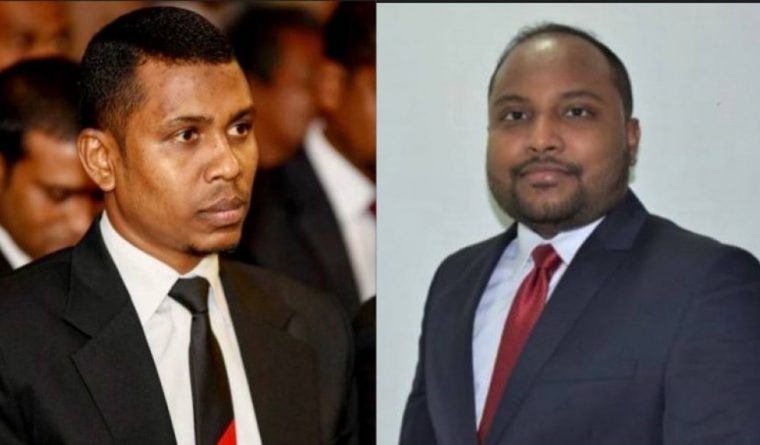
It has been revealed that Criminal Court Judge Mohammed Misbah was in charge of preparing the report and verdict in the bribery and money laundering case filed against former President Yameen in relation to the MMPRC lease transaction.
While the verdict hearing is scheduled for Sunday, a criminal court official stated, “Two weeks ago, judge Ahmed Shakeel went on leave and handed the case report to Judge Misbah.”
According to the official, the scanned copy of the documents submitted by the state in the case, as well as all material statements taken during the trial, were typed and handed over to Judge Misbah, who wrote the report on behalf of the government at the request of Chief of Staff at the President’s Office Ali Zahir.
A source close to Chief of Staff Ali Zahir confirmed that Judge Misbah was appointed as a Criminal Court judge through him.
Involving another judge in any work of reporting or writing the judgment of a case assigned to a particular judge is completely against the discipline and integrity of the judges in a superior court, with the exception of situations where a bench of judges has been constituted to investigate a case in accordance with the Court Act.
After the conclusion of the hearing held on November 30 to receive the statement, Judge Shakeel stated that the sentencing hearing would take place within a month. Shakeel took an annual leave of absence two weeks ago. However, he abruptly cut short his leave and returned to work yesterday.
Shakeel returned to court after Judge Misbah drafted the report and verdict in the case, according to a criminal court official. The official’s arguments are bolstered by the fact that he scheduled the verdict in the Island case for Sunday as the first thing he did after returning to court today.
Judge Misbah is also hearing a bribery case filed against Ahmed Mahloof, the current government’s youth minister. Previously, the court had dismissed Mahloof’s case based on his earlier submissions during the preliminary stage of the case. According to a criminal court official, it was done directly under the influence of the government this time as well. However, the High Court later overturned Misbah’s decision and decided to continue with the case.
Judge Misbah has also represented Abdulla Ziyath, the former MMPRC managing director who was one of the main masterminds of the MMPRC scandal and was convicted through a private confession. He had also appeared in court as a defense attorney in the case. Abdulla Ziyath has been under house arrest since the regime’s inception as part of a deal with the government, and it is understood that Judge Misbah is already in close contact with Ziyath.
Previously, the prosecutor general had written to the criminal court, expressing concern about Misbah taking up minister Mahloof’s case. The office stated in the letter that it considered it a conflict of interest for Misbah to investigate the matter because he was a lawyer for one of the masterminds of the MMPRC scam. Misbah, on the other hand, refused to withdraw from the case. However, in accordance with the JSC’s treatment of judges, no action has been taken against Misbah.
Former Vice President Ahmed Adeeb and Abdulla Ziyath are the two main witnesses named in all of the cases filed against President Yameen in connection with the MMPRC scandal. In the Vodamulla case, the Supreme Court also ruled that the two witnesses’ testimony was inadmissible in the absence of additional evidence to corroborate it.
The Criminal Court has ten judges, and all four cases against President Yameen have been assigned to Chief Justice Shakeel’s section. According to the official, while the court’s cases are divided among the judges, all of President Yameen’s cases have been transferred to Shakeel’s section in order to influence the court’s registrar. Otherwise, he pointed out, it would be impossible for all cases to fall under the chief justice’s control.
Shakil withdrew from the Fuggiri case earlier this week and handed it over to judge Ali Nadeem. Before being appointed as a judge, Ali Nadeem also worked as a lawyer for the former vice president in the MMPRC graft case. Shakeel’s withdrawal from the case was not explained by the criminal court, and it was also unclear how the sudden emergence of the reason for the non-compliance was not explained during earlier hearings in the case.
Long before the Aarah was lodged, the Fuggiri case was filed in criminal court and investigated by Shakeel. However, the hearings in the case were halted and kept in the courtroom where the preliminary submissions were filed. The Criminal Procedure Code establishes clear timelines for pre-trial submissions, accountability, and trial court decision-making. The JSC recently took cognizance of disciplinary proceedings against a number of other judges who failed to perform within the time period specified in the Criminal Procedure Code.