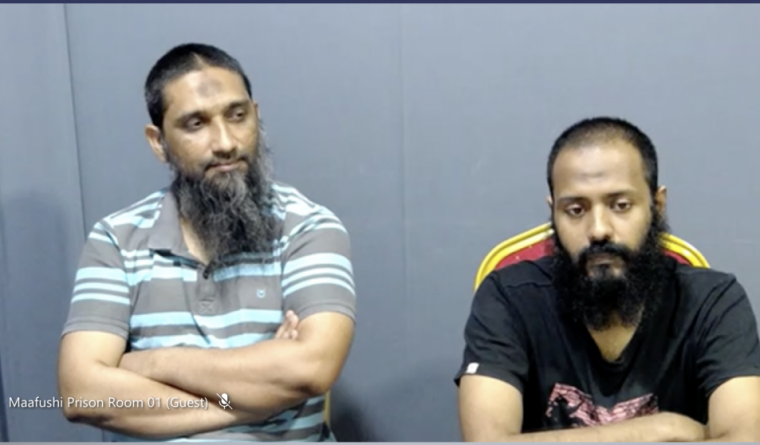
According to certain media sources, Abdulla Ali, who was detained on suspicion of organizing the deadly attack on Parliament Speaker Mohamed Nasheed on May 6, 2021, was only charged with planning the attack and not with conspiring to carry it out.
Pro-government newspapers ran headlines stating that Abdulla Ali Manik had received a five-year prison sentence after the Criminal Court found him responsible for the attack on President Nasheed.
President Ibrahim Mohamed Solih granted Abdullah freedom on bail while he was incarcerated on terrorism-related accusations.
When Abdullah Ali faced the police during the 2007 Himandhoo episodes, he was one of the masterminds of the violence. He was given a 10 year prison term in the case on May 15, 2008.
He managed to escape from jail twice while serving his term. He was apprehended for the first time in Thinadhoo in 2009 while he was evading authorities, and he was apprehended again in 2010 while attempting to escape from jail. He received a penalty of disobedience in both instances.
He was granted bail in 2019 after failing to serve his full sentence. His sentence was reduced to three days, and he was released on May 5, 2019, as cited by papers seen from the publication Mihaaru.
He was granted bail in 2019 after failing to serve his full sentence. His sentence was reduced to three days, and he was released on May 5, 2019, according to papers accessed by the online publication Mihaaru.
The President’s Office Legal Council Ahmed Abdulla Afeef signed the letter. “Under the authority granted by Section 29 of the (Remission and Remission of Sentence) Act, the Criminal Court No. 2007/JC/1896 has sentenced Abdulla Ali Manik (card number —) of Molhadhoo, Bahar, North Thiladhummathi to 10 (ten) years in jail. In his letter, he stated, “I am writing to inform you that it has been agreed to abbreviate the day to 3 (three) days.
While incarcerated, Ali Abdullah has been charged with brainwashing individuals and disseminating extremist ideas. Additionally, he is charged with attempting to propagate extremist ideas after being freed from prison. He was detained in connection with the attack on Nasheed, and according to authorities, he was one of the attack’s planners. But upon the investigation’s conclusion, he was accused of aiding a terrorist group. As a result, he was not held accountable for organizing and carrying out the assassination attempt on President Nasheed.
“The investigation into the attack on the Speaker on May 6 has been thoroughly conducted and the charge sheet has been filed,” Addu Meedhoo MP Rozaina Adam tweeted in response. “However, upon Abdullah Ali’s detention, the authorities asserted that he was the attack’s chief planner and organiser. Under Section 7 of the Prevention of Terrorism Act, a person who planned and organized a terrorist attack may be prosecuted with conspiring to conduct a terrorist act. He may spend 17 to 20 years in prison if proven guilty.
Indictment brought up against Abdulla Ali Manik:
According to Section 16(a) of the Prevention of Terrorism Act, someone who does an act is guilty of an offense if similar circumstances arise in the future.
(1) To urge support for or provide assistance to a terrorist group
(2) expressing opinions in such a way as to suggest that one is a supporter of a specific terrorist group, or defending the actions of a terrorist organization and arguing that such actions are justified, and that the respondent may rely on the opinion expressed in such a manner, without caring whether he or she may be motivated to support a terrorist organization.
(3) It is widely known that a particular gathering is held to solicit support for a terrorist group, to publicise the activities of a terrorist group, to give a platform to someone claiming allegiance to a terrorist group, or to hear from someone openly supporting a terrorist group. help in organising or planning
(4) speak at or address a gathering while being aware that it is being held to solicit support for or to publicize the operations of a terrorist organization.
(5) possess or use a document, piece of artwork, or photograph that claims the owner is a terrorist or an organisation’s supporter.
The aforementioned paragraph makes it very apparent that neither this article nor the offense it refers to have anything to do with carrying out or preparing for terrorist attacks. Therefore, it cannot be argued that Abdullah was charged in connection with the May 6 attacks. The charge that was emphasized in the case was one that was brought up in a totally unrelated incident.
The fact that no charges have been filed against Abdulla Ali Manik despite his detention in connection with the May 6 attacks was one of the arguments made in his favour during the sentence hearing.
Mohammed Tasleem, who was detained by the police on suspicion of planning the attacks of May 6, is also accused of aiding a terrorist organization in its campaign against Abdullah Ali Manik. Even that accusation against him has not been proven.